

Cone crusher structure description
A cone crusher is a widely used crushing machine in the mining and construction industries, designed to crush hard and medium-hard materials such as limestone, granite, basalt, and ores like copper, iron, and gold. It uses compression force to break down the material, making it ideal for secondary, tertiary, and even quaternary crushing stages.
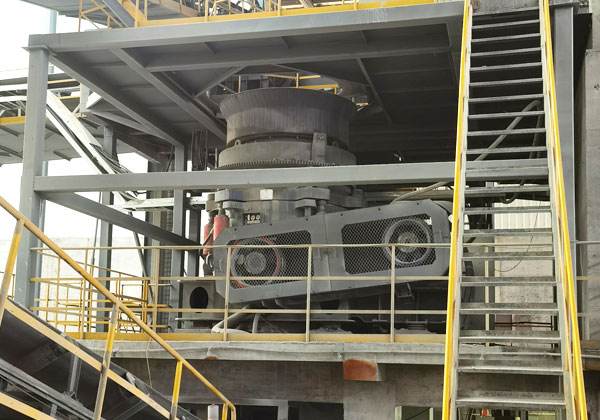
Basic Structure
- Frame: The frame is the main support structure of the cone crusher. It provides a rigid foundation for the rest of the components. Most cone crushers have a heavy-duty, welded steel frame that supports the main shaft, the crushing chamber, and the hydraulics. The frame typically includes the lower frame, upper frame, and an integral hub that connects the machine to the foundation.
- Main Shaft: The main shaft is a key component that connects the motor to the crushing elements. It is positioned vertically and extends from the motor to the bottom of the crushing chamber. The shaft rotates inside the eccentric sleeve and is responsible for transferring the rotational power to the mantle.
- Eccentric Assembly: The eccentric assembly, which includes the eccentric bushing and the eccentric shaft, controls the movement of the mantle. The eccentric shaft is powered by the drive motor and causes the mantle to move in a circular or oscillating motion inside the crushing chamber. This movement is crucial for crushing materials.
- Mantle: The mantle is the moving part of the cone crusher. It is a large, concave surface that moves in a circular motion inside the crushing chamber, gradually crushing material between itself and the stationary bowl liner. As the mantle gyrates, it applies pressure to break down large rocks into smaller fragments. The mantle is replaceable and typically made from high-grade manganese steel for durability.
- Bowl Liner: The bowl liner is a stationary part of the cone crusher. It is a concave surface that fits around the outer rim of the crushing chamber and works in conjunction with the mantle to crush materials. The bowl liner is also made from high-grade materials to withstand the crushing forces. It is fixed to the frame and can be replaced when worn.
- Hydraulic System: The hydraulic system is used to adjust the size of the discharge opening, also known as the CSS (closed side setting), which determines the final size of the crushed material. The hydraulic cylinder can raise or lower the bowl, allowing for the control of the gap between the mantle and the bowl liner. Additionally, the hydraulic system is used for overload protection, which ensures that the crusher does not suffer damage when uncrushable materials enter the chamber.
- Drive Motor and Pulley: The drive motor is responsible for providing the rotational power needed to operate the cone crusher. The motor is connected to a pulley and a belt drive system that transfers the power to the main shaft via the eccentric assembly. The drive motor typically operates at high RPM to generate sufficient speed for the crushing process.
- Dust Seal: The dust seal is a critical component designed to protect the internal parts of the cone crusher from dust, dirt, and debris that may be generated during the crushing process. It prevents contaminants from entering the bearings and other sensitive parts, which could lead to premature wear or failure.
- Discharge Chute: The discharge chute is where the crushed material exits the cone crusher after it has been processed. The material is collected in a chute that directs it to further processing or conveyor systems for transportation to the next stage of production.
- Adjusting Ring: The adjusting ring, often hydraulically operated, supports the adjustment of the distance between the mantle and the bowl liner. This feature allows for fine-tuning of the crushing process and provides a means of controlling the output size by adjusting the clearance between the crushing surfaces.
Operation and Crushing Process
The cone crusher works through a combination of crushing action, which involves compressing the material between the mantle and bowl liner. The eccentric assembly creates an oscillating motion that forces the material downward through the crusher. The gap between the mantle and bowl liner narrows as the material passes through, and the resulting pressure fractures the material. The final crushed product exits through the discharge chute.
The cone crusher’s efficient design and adjustable settings make it suitable for various types of crushing applications, including primary, secondary, and tertiary stages of processing.