

Mineral Vibrating Feeder
A mineral vibrating feeder is a type of equipment used in mining, aggregate, and processing industries to transport bulk materials from a storage bin or hopper to a crusher, screen, or conveyor. It plays a crucial role in the material handling process, ensuring a consistent and controlled feed rate to subsequent processing stages. Here’s an overview of mineral vibrating feeders, their working principle, advantages, and applications.
Working Principle
Mineral vibrating feeders are designed to use vibration to move bulk materials. They consist of a vibrating body with a feed trough, an electromagnetic or mechanical drive unit, and a spring suspension system. The vibrating body creates a linear or rotary motion, depending on the design, which helps move the material from the hopper to the next processing stage. The drive unit, whether electromagnetic or mechanical, induces the vibration by causing the feeder tray to oscillate at a specific frequency and amplitude. This movement causes the material to be conveyed smoothly along the feeder’s trough and into the desired location.
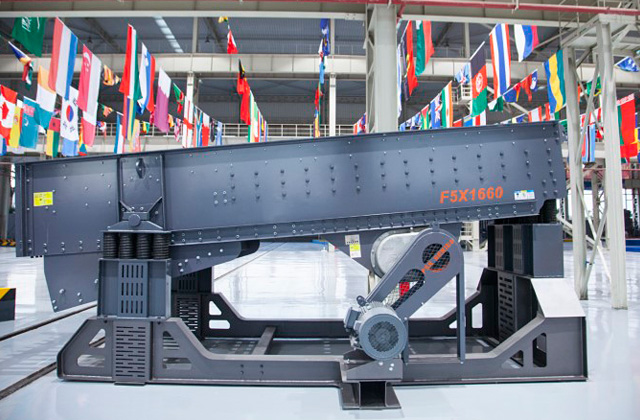
The vibration helps to reduce the chances of material clogging or blocking the feeder. It also provides a controlled, uniform feed rate, which is critical in maintaining efficiency in the crushing and screening processes that follow. The vibrating feeder’s design allows for adjustment of the feed rate and material flow, accommodating variations in material density, size, and flow properties.
Benefits of Mineral Vibrating Feeders
- Efficient Material Handling: Vibrating feeders are capable of handling a wide range of materials, including those with variable particle sizes and weights. The consistent movement provided by the vibration mechanism ensures a steady supply of material to crushers, screens, and other processing equipment, which enhances overall productivity and efficiency.
- Reduced Downtime: By preventing material blockages and maintaining a steady flow, vibrating feeders reduce downtime associated with manual interventions and equipment jams. This leads to lower maintenance costs and a more streamlined processing operation.
- Adjustable Feed Rate: The feed rate of a mineral vibrating feeder can be easily adjusted by changing the amplitude and frequency of vibrations. This feature is particularly useful in processes where precise material feed rates are required for optimal performance of subsequent processing stages.
- Durability and Longevity: Mineral vibrating feeders are built to withstand harsh mining environments. The use of high-quality materials and robust construction ensures longevity and durability, reducing the need for frequent replacements and repairs.
Maintenance and Troubleshooting
Regular maintenance is crucial for the optimal performance of vibrating feeders. Common maintenance practices include regular cleaning, inspection of the feeder’s springs and mounts, lubrication of the vibrating motor, and checking the wear condition of the feeding tray or chute. Troubleshooting common issues such as material flow irregularities, excessive noise, or vibrations can often be addressed by adjusting the feeder’s settings or replacing worn parts.
Specifications – Technical Data
| Model | Feed Chute Size W×L(mm) |
Obliquity(°) | Bar Length (mm) |
Maximum Feed Size (mm) |
Speed (r/min) |
Capacity (t/h) |
Power (kw) |
Matched Jaw Crusher |
| F5X1036H | 1000×3600 | 8 (0-15) | 2×900 | 600 | 650-900 | 350 | 15 | HJ98/HJ110/ PEW760/PEW860/ PE600×900/ PE750×1060/ PE900×1200/ PFW1214Ⅱ/ PFW1315Ⅱ/ PFW1318Ⅱ |
| F5X1245H | 1200×4500 | 2×900 | 700 | 600 | 22 | HJ110/ PE900×1200/ PFW1318Ⅱ/ HJ125/PEW1100/ PE1100×1200/ PFW1415Ⅱ |
||
| F5X1260H | 1200×6000 | 3×900 | 700 | 600 | 22 | HJ125/ PE1000×1200/ PEW1100/PFW1415Ⅱ |
||
| F5X1560H | 1500×6000 | 3×900 | 900 | 900 | 30 | C6X140/ PE1200×1500 |
||
| F5X1860H | 1800×6000 | 3×900 | 1100 | 1200 | 37 | C6X160/ PE1500×1800 |
||
| F5X2160H | 2100×6000 | 3×900 | 1300 | 1600 | 45 | C6X200 |
Notice:
1. Any change of European Type Jaw Crusher technical data shall not be advised additionally.