

Secondary Cone Crusher
A secondary cone crusher is a critical piece of equipment in the crushing process, specifically designed to handle the reduction of material size after the initial primary crushing stage. These crushers play a key role in producing finer aggregates or secondary crushed materials, which are ideal for construction, mining, and various industrial applications.
Function and Operation:
Secondary cone crushers are used after the primary crushing stage to further reduce the size of material. They are typically used to process medium-hard to hard rock and ore, such as limestone, granite, basalt, and other types of aggregate. The cone crusher uses a rotating crushing cone in combination with an eccentric drive to create compressive forces that break down material into smaller pieces.
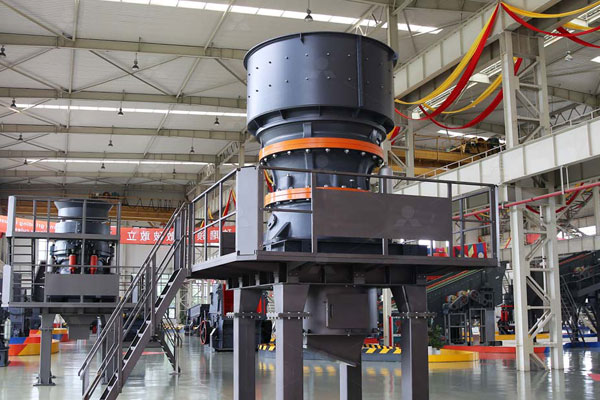
The material fed into the secondary cone crusher enters through the top, where it is initially struck by the mantle – a movable inner part of the cone. The mantle is positioned within a concave bowl, which serves as a fixed outer structure. As the mantle rotates, it moves in an elliptical pattern, causing the material to be compressed, sheared, and fractured against the bowl liner. The crushing action reduces the material to a uniform size, making it suitable for further processing or for use as end products.
Advantages of Secondary Cone Crushers:
- Crushing Chamber Design: Secondary cone crushers feature a compact design with a steep crushing chamber, which allows for a high reduction ratio. The design ensures effective compression and reduction of feed material, helping achieve uniform particle sizes. The crushing chamber is equipped with replaceable liners, often made of manganese steel or a similar wear-resistant material, to withstand high impact forces and abrasive materials.
- Adjustable Settings: One of the significant advantages of secondary cone crushers is their adjustable settings. Operators can modify the closed-side setting (CSS) to control the size of the output material. This flexibility allows for the production of a variety of end-product sizes, which can be crucial in meeting specific aggregate specifications or recycling requirements.
- High Efficiency and Productivity: Secondary cone crushers are designed for high efficiency, offering substantial throughput and performance. They can handle a wide range of feed materials, including hard rocks like granite, basalt, and quartz, as well as softer materials like limestone and sandstone. These machines often come with advanced automation features, such as hydraulic adjustments and overload protection, to enhance performance and reduce downtime.
- Versatility: Secondary cone crushers can be configured with various concave and mantle designs, allowing them to handle different types of material and crushing applications. They are available in different sizes and capacities, from small units suitable for mobile applications to larger machines that can be installed as part of a fixed crushing plant. Their versatility makes them suitable for use in a variety of industries, including mining, construction, and aggregate production.
- Safety Features: Modern secondary cone crushers come equipped with safety features to protect operators and maintenance personnel. These include hydraulic tramp iron relief systems that allow the crusher to pass uncrushable objects without causing damage, and advanced lubrication systems that keep the crusher running smoothly. These safety features are designed to minimize the risk of accidents and equipment failure.
Maintenance and Operation Tips:
To ensure optimal performance, proper maintenance of secondary cone crushers is essential. Regular inspection, lubrication, and monitoring of critical components such as the mantle, concave, and hydraulic systems are recommended. Overheating, wear, and wear plate replacement are typical maintenance tasks to maintain efficiency and extend the crusher’s life.
Operators should follow recommended operating guidelines and keep the crusher settings correctly adjusted. Excessive feed or oversized material can cause damage to the crusher and reduce its efficiency. Regular checks on lubrication, hydraulic pressure, and temperature can help prevent failures and ensure the equipment runs smoothly.
Specifications – Technical Data
| Model | Cavity | Maximum feed(mm) | Min CSS(mm) | Capacity(t/h) | Power(kw) |
|---|---|---|---|---|---|
| HST100 | S1(Extra Coarse) | 240 | 22 | 85-170 | 90 |
| H1(Fine) | 135 | 10 | 45-115 | ||
| H2(Medium Fine) | 65 | 8 | 35-80 | ||
| H3(Extra Fine) | 35 | 4 | 27-60 | ||
| HST160 | S1(Extra Coarse) | 360 | 25 | 120-345 | 160 |
| S2(Medium Coarse) | 300 | 22 | 105-305 | ||
| S3(Coarse) | 235 | 19 | 90-275 | ||
| H1(Fine) | 185 | 13 | 66-210 | ||
| H2(Medium Fine) | 90 | 10 | 65-165 | ||
| H3(Extra Fine) | 50 | 6 | 48-105 | ||
| HST250 | S1(Extra Coarse) | 450 | 35 | 255-605 | 250 |
| S2(Medium Coarse) | 400 | 29 | 215-515 | ||
| S3(Coarse) | 300 | 25 | 190-490 | ||
| H1(Fine) | 215 | 16 | 110-395 | ||
| H2(Medium Fine) | 110 | 13 | 115-340 | ||
| H3(Extra Fine) | 70 | 8 | 90-255 | ||
| HST315 | S1(Extra Coarse) | 560 | 41 | 335-1050 | 315 |
| S2(Medium Coarse) | 500 | 38 | 305-895 | ||
| 275 | 16 | 170-665 | |||
| H2(Medium Fine) | 135 | 16 | 190-505 | ||
| H3(Extra Fine) | 65 | 13 | 205-320 | ||
| HST450 | S1(Extra Coarse) | 560 | 54 | 500-1300 | 450 |
| S2(Medium Coarse) | 465 | 51 | 450-1200 | ||
| HST560 | H1(Fine) | 300 | 22 | 430-1515 | 560 |
| H2(Medium Fine) | 155 | 19 | 380-1375 | ||
| H3(Extra Fine) | 80 | 10 | 270-775 | ||
| HST750 | H1(Fine) | 370 | 25 | 460-2130 | 750 |
| H2(Medium Fine) | 195 | 22 | 525-1605 | ||
| H3(Extra Fine) | 85 | 10 | 350-885 |