

Quartz stone crushing and processing plant
Quartz stone, a naturally occurring mineral composed of silicon dioxide (SiO2), is one of the most abundant minerals in the Earth’s crust. Its applications span various industries, including construction, electronics, and manufacturing, owing to its durability, hardness, and resistance to weathering. In order to make quartz more useful in these industries, it undergoes a process of crushing, screening, and further refinement. This process takes place in a quartz stone crushing and processing plant, where raw quartz is transformed into usable aggregate or other forms.
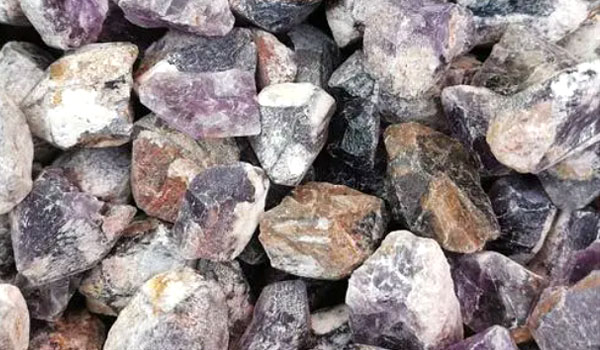
1. Quartz Stone Crushing Process
The crushing of quartz stones is a multi-stage process that aims to reduce large pieces of raw quartz into smaller, more manageable sizes. The primary stages include:
- Feeding: The raw quartz is first transported to the plant and fed into a feeder system. A vibrating feeder or belt conveyor is often used to transport the material to the primary crushing area.
- Primary Crushing: In this step, the raw quartz is fed into a jaw crusher or a gyratory crusher. Jaw crushers are typically employed in the primary crushing stage because they can handle large feed sizes and reduce the stone size to a manageable level. The jaw crusher’s large, powerful jaws break the quartz stone into coarse aggregate, usually ranging from 50 mm to 200 mm in size.
- Secondary Crushing: After primary crushing, the material is further reduced in size using secondary crushers, such as cone crushers or impact crushers. The cone crusher is ideal for achieving finer sizes, and it produces material with a more consistent shape. Impact crushers, on the other hand, can break quartz into fine aggregates by applying high-speed impact force.
- Screening: The crushed material is then passed through various sieves or vibrating screens to separate the particles into different size categories. Larger stones are sent back to the crushers for further reduction, while smaller particles are moved to the next stage.
- Fine Crushing: For the production of fine quartz sand or powder, fine crushers such as vertical shaft impact crushers (VSI) may be employed. VSI crushers are effective for achieving very fine material, particularly when sand production is the goal. These crushers are designed to produce a high percentage of sand-sized particles, which are essential in the production of quartz sand for use in industries like glassmaking and construction.
2. Equipment Used in Quartz Processing
The equipment used in quartz stone crushing and processing plants includes:
- Jaw Crushers: For initial reduction of large quartz blocks.
- Cone Crushers: For further reduction and shaping.
- Impact Crushers: For producing finer quartz sand and aggregates.
- Vibrating Screens: For grading and separating the material.
- VSI Crushers: For producing high-quality, fine quartz sand.
- Magnetic Separators: For removing impurities such as iron.
3. Applications of Processed Quartz
Processed quartz can be used in various industries:
- Construction: Crushed quartz aggregates are widely used in concrete production, road construction, and as decorative stone.
- Glass Manufacturing: High-quality quartz sand is a key ingredient in the production of glass.
- Electronics: High-purity quartz is used in the electronics industry for semiconductors, optics, and other high-tech applications.
- Industrial Minerals: Processed quartz is also used in ceramics, coatings, and as a filler in products like paints and plastics.
A quartz stone crushing and processing plant is essential for turning raw quartz into a variety of valuable products. By employing a combination of crushers, screens, and other machinery, the plant can produce fine aggregates, sand, and powders that serve industries such as construction, electronics, and manufacturing. With the growing demand for quartz in various sectors, the efficient operation of such plants is crucial to meet market needs.